Senior Cycling Course in Kampen: Free Training for Safer Cycling
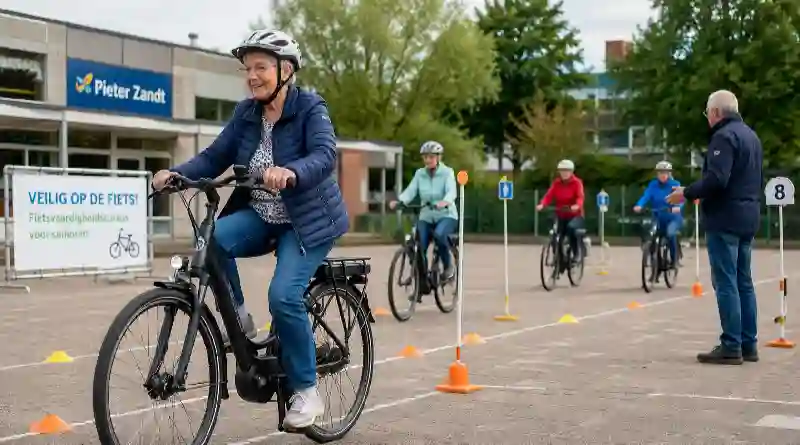
From Saturday 26 September 2026, seniors in the municipality of Kampen can join the free senior cycling course ‘Veilig op de fiets!’ (‘Safe on the Bike!’). In ten weekly sessions, a physiotherapist helps participants build their cycling skills and confidence. They practise mounting and dismounting, steering, braking and safe manoeuvring. Riders of ordinary bikes and e-bikes are both welcome. The sessions take place in the schoolyard of the Pieter Zandt school in Kampen.
For many older people, cycling is much more than exercise. A bike lets you do your own shopping, visit family or friends and get out of the house. Cycling is also a pleasant way for many seniors to stay active and mobile. However, that confidence can fade when some things get harder on the bike or after a fall. The fear of falling again can even make someone cycle less often.
So the course in Kampen is not only for people who already feel unsure. Seniors who want to work on their skills as a precaution can join too. By practising in a controlled setting, participants find out what goes well and which skills need extra attention.
Ten Sessions for Safer Cycling
The senior cycling course consists of ten weekly sessions of one hour each. Every session focuses on improving and maintaining skills that matter in everyday cycling.
For example, participants practise getting on and off the bike. That may sound simple, but at low speed and when stopping, a cyclist has to keep their balance. Steering, braking and manoeuvring are practised as well.
The advantage of several sessions in a row is that participants can repeat skills more often. After all, doing something once is different from doing it more easily and with more confidence each time.
A physiotherapist leads the course. As a result, the exercises can take account of each participant’s abilities and points for attention.
A Personal Intake First
An intake takes place before the course. It shows which points for attention apply to each participant.
That matters because not every older person joins for the same reason. One participant wants to get on and off more easily, for example, while another mainly wants more confidence when braking or manoeuvring.
Seniors who still cycle without problems can also take part and practise their skills as a precaution. So the course is not only for people who have fallen or who now feel unsure on the bike.
Because the physiotherapist looks at each personal situation in advance, the sessions can focus on the skills that matter most to each participant.
Practising on Your Own Bike
A practical part of the course is that participants train on their own bike. This means they do the exercises on the bike they normally ride.
After all, every bike reacts differently. The position of the handlebars, the height of the saddle, the brake controls and the general riding position can all differ. The weight and geometry of a bike also affect how it feels when riding and manoeuvring.
By practising on their own bike, participants can take what they learn more easily into their daily rides.
That can come in handy on a trip to the supermarket, a visit to family or a leisure ride around Kampen.
Seniors With an E-Bike Can Join Too
Participants who use an electric bike are welcome on the course as well. That matters because the e-bike has become an important way of getting around for many seniors.
Electric assistance can make it possible to keep cycling longer distances and, for example, to handle headwinds more easily. At the same time, an e-bike demands good control of the bike.
An electric bike can be heavier than a similar ordinary bike. The motor’s assistance also affects how the bike reacts when you pull away and while you ride. Therefore skills such as mounting and dismounting well, braking gently, steering and manoeuvring remain important.
During the course, participants can practise all of this on the e-bike they normally use.
Cycling Skills Support Independence
For many seniors, the bike plays an important role in staying independent and taking part in daily life. Anyone who gets on the bike easily does not always need a car or other transport for short and medium distances.
A trip to a shop, club, friend or relative is often easy by bike. Besides that, cycling has a social and leisure side. Cycling with others, or taking a ride on your own, can be an important part of the daily or weekly routine.
When someone starts to feel unsure, that can change their behaviour. They might avoid a busy junction, skip a longer ride or leave the bike at home more often.
That is exactly why it makes sense to look at cycling skills before cycling becomes really difficult. Practising as a precaution can also help you stay aware of the skills you need to keep the bike under control.
Confidence Can Fade After a Fall
The course is also for people who now feel a little less sure on the bike. That uncertainty can have several causes.
An earlier fall, for example, can affect confidence. Even if someone was not seriously hurt, the next ride can feel different. A cyclist may become more careful, sit tensely on the bike or try to avoid certain situations.
Gradual changes can also play a part. Things that came naturally for years can need more attention in later life. Think of looking over your shoulder, reacting quickly, taking a sharp bend or pulling away from a standstill.
That does not automatically mean someone should stop cycling. It can instead be a reason to practise certain skills again, consciously.
The course ‘Veilig op de fiets!’ gives participants a place to train under guidance.
Mounting and Dismounting: Safe Cycling for Seniors in Kampen
One of the skills in the senior cycling course is mounting and dismounting. It is an important part of cycling because you do many things at once for a short time.
When pulling away, a cyclist has to keep the bike balanced, put force on the pedals, steer and keep an eye on the surroundings. When stopping, it is more or less the opposite: slow down, brake in a controlled way and put a foot down at the right moment.
So it can be useful to practise these movements separately.
The set-up of the bike can matter here too. If someone struggles to reach the ground or has trouble with the brake controls, it can be wise to have someone check that the bike fits the rider and is set up correctly.
Braking Well and in Control
Besides mounting and dismounting, braking is a key part of bike control. In daily traffic, a cyclist regularly has to slow down or stop completely.
Think of traffic lights, crossings, cyclists who brake unexpectedly or cars coming out of a side street. Braking well means not only using enough braking force, but also keeping the bike under control while slowing down.
That takes routine and confidence.
By practising braking on purpose during a session, a participant learns how their own bike reacts. That can be especially valuable on a bike that is heavier than, or reacts differently from, the one they rode before.
Steering and Manoeuvring in Everyday Situations
The course also pays attention to steering and manoeuvring. These skills come up every day too.
Think of a narrow cycle path, passing an obstacle, a bend at a junction or riding among other cyclists. Besides, keeping your balance gets harder at low speed.
In an exercise, participants can focus on this without dealing with all the bustle of normal traffic.
The schoolyard of the Pieter Zandt school gives the course a fixed training location in Kampen.
Check Your Own Bike Regularly Too
Good cycling skills are one part of safe cycling. The technical condition of the bike is at least as important.
If you cycle regularly, it is wise to check your bike from time to time. Pay attention to the brakes, tyres and lighting, among other things. Also check that the handlebars and saddle are secure and that the bike is set up comfortably.
On an e-bike, the general working of the electric system deserves attention as well.
If you are unsure about the technical condition or set-up of your bike, a check by a bike mechanic can be a good idea. A well-maintained bike does not remove every risk, but it does let you rely on parts such as the brakes, tyres and lighting.
When and Where Is the Senior Cycling Course in Kampen?
The first session of ‘Veilig op de fiets!’ takes place on Saturday 26 September 2026 from 3 pm to 4 pm.
The sessions take place at:
Schoolyard of the Pieter Zandt school
Kampen
There are ten weekly sessions of one hour in total. An intake takes place before the course.
The course is free for residents of the municipality of Kampen. It runs in cooperation with Fietsvalpreventie.nl (a cycling fall prevention organisation).
Please bring your own bike. You can use both ordinary bikes and electric bikes on the course.
Sign Up for the Senior Cycling Course in Kampen
Seniors from the municipality of Kampen who want to join can sign up on the website of Sportservice Kampen (the local sports service):
Sign up:
www.sportservicekampen.nl/fietsweek
If you have questions about the course, you can contact Sportservice Kampen at:
Email: info@sportservicekampen.nl
Phone: 038 205 31 80
Because the course is a series of ten sessions with an intake beforehand, it is wise to sign up in good time.
The course suits seniors who still cycle regularly and with confidence and want to work on their skills as a precaution. It is also for residents who notice that certain things are getting harder, or who feel less sure after a fall.
So ‘Veilig op de fiets!’ is not only about preventing a fall. It also aims to help seniors keep using their bike with confidence for as long as possible, for daily, social and leisure rides.
After reading about the senior cycling course in Kampen, a few practical questions often remain. Below, we answer the most common ones.
When Does the Cycling Course Veilig op de Fiets Start in Kampen?
This course starts on Saturday 26 September 2026. The first session runs from 3 pm to 4 pm in the schoolyard of the Pieter Zandt school in Kampen. In total, it has ten weekly sessions of one hour each. An intake beforehand shows which cycling skills need extra attention for each participant.
Is the Senior Cycling Course in Kampen Free?
Yes, ‘Veilig op de fiets!’ is free for residents of the municipality of Kampen. The course has ten sessions led by a physiotherapist. Participants use their own bike for the exercises. You can sign up through the special page of Sportservice Kampen.
Can I Join the Cycling Course With an E-Bike?
Yes, seniors who normally ride an e-bike can join too. Participants practise on their own bike, so they can train skills such as mounting, dismounting, steering, braking and manoeuvring on the bike they use every day. An intake beforehand shows which points for attention matter for each participant.
Who Is the Veilig op de Fiets Course For?
The course is for seniors from the municipality of Kampen who want to improve or maintain their cycling skills. People who want to practise as a precaution can join, and so can cyclists who now feel a little less sure. Practising different cycling skills can also help if someone has lost confidence after a fall.
Where Can I Sign Up for the Cycling Course in Kampen?
You can sign up through Sportservice Kampen at www.sportservicekampen.nl/fietsweek. For further questions, you can get in touch via info@sportservicekampen.nl or by phone on 038 205 31 80. An intake takes place before the ten sessions, and it looks at each participant’s personal points for attention.
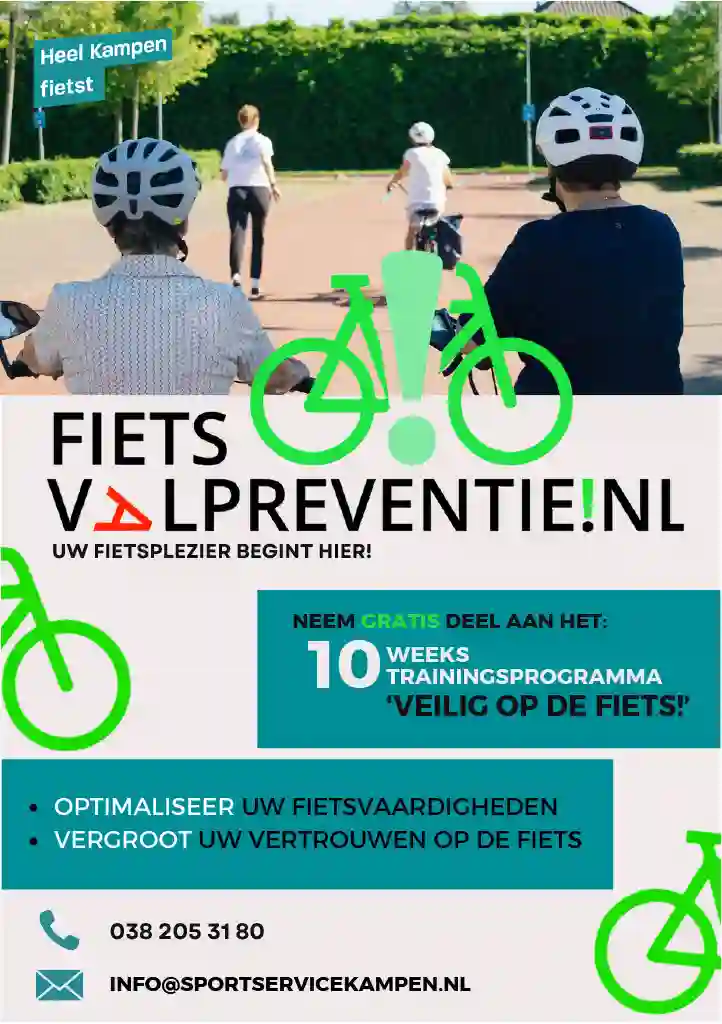
Poster for cycling fall prevention