Amsterdam Is Making More Room for Cyclists at Junctions
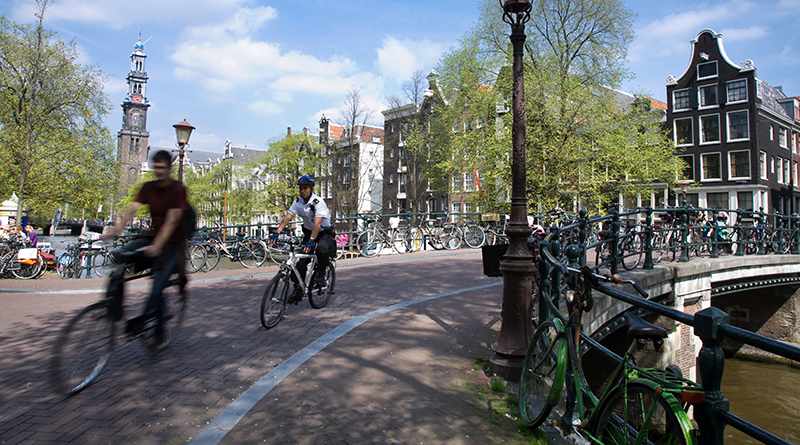
Small measures, better flow. In the coming period, Amsterdam wants to make more room for cyclists at its busiest junctions with relatively small measures. The city is working on larger waiting areas, different traffic light settings and removing “islands”. These changes are needed to improve the safety and efficiency of bike traffic.
Research into Cyclist Behaviour
In 2014, the University of Amsterdam studied how cyclists use the city’s busy junctions. At nine big Amsterdam junctions, researchers mapped the behaviour of almost twenty thousand cyclists with video and interviews. The study looked at how cyclists interact with the design, with each other and with other road users at large, busy junctions. It showed that most of the junctions studied have far too little capacity. As a result, many cyclists go their own way. They cut corners, use the pavement, follow desire paths, bend the priority rules or ignore the red light.
Not Enough Waiting Space
A key finding was that most junctions have far too little space for waiting at the traffic lights. This causes a lot of extra chaos, because waiting cyclists block other routes. These and other findings have led to a series of junction changes that will be made in the coming period. By increasing capacity and changing the design of the junctions, the city hopes to improve flow and safety.
Improvements Already Made
Some improvements for cyclists are already done. For example, the city redesigned the Stadhouderskade junction in front of the Rijksmuseum. At several junctions, such as Weteringcircuit, Frederiksplein and Ceintuurbaan/Amsteldijk, it set the traffic lights to be more bike-friendly. These changes let cyclists cross faster and more safely.
Future Changes
The municipality of Amsterdam will remove the “islands” at other junctions or make them smaller, to make more room for cyclists. It will also widen the crossing for cyclists at some points and enlarge the bike waiting areas. By changing markings and shortening zebra crossings, it also wants to give cyclists more space. A green wave should keep cyclists moving, which means they can hit several green lights in a row. This increases efficiency and reduces waiting times.
Making Room for Cyclists: Safety and Efficiency
These measures are a direct answer to the findings of the study and to observations of daily practice. By adapting and improving the infrastructure, Amsterdam wants to make cycling even more attractive as a way to get around. This fits the city’s wider goals of promoting sustainability and improving air quality.
Long-Term Planning
Amsterdam has a long tradition of bike-friendly policy and keeps investing in improvements. These changes are part of a bigger plan to make the city future-proof for cyclists. The pressure on the infrastructure will probably only increase, so it is essential to put solutions in place proactively.
Amsterdam keeps working to improve its cycling infrastructure. With small, targeted measures, the city can greatly improve the flow and safety of cyclists. This makes room for cyclists and turns cycling into an even more attractive and safer alternative for daily travel.


