Bike Saddle Adjustment: Why Setting Up Your Saddle Matters
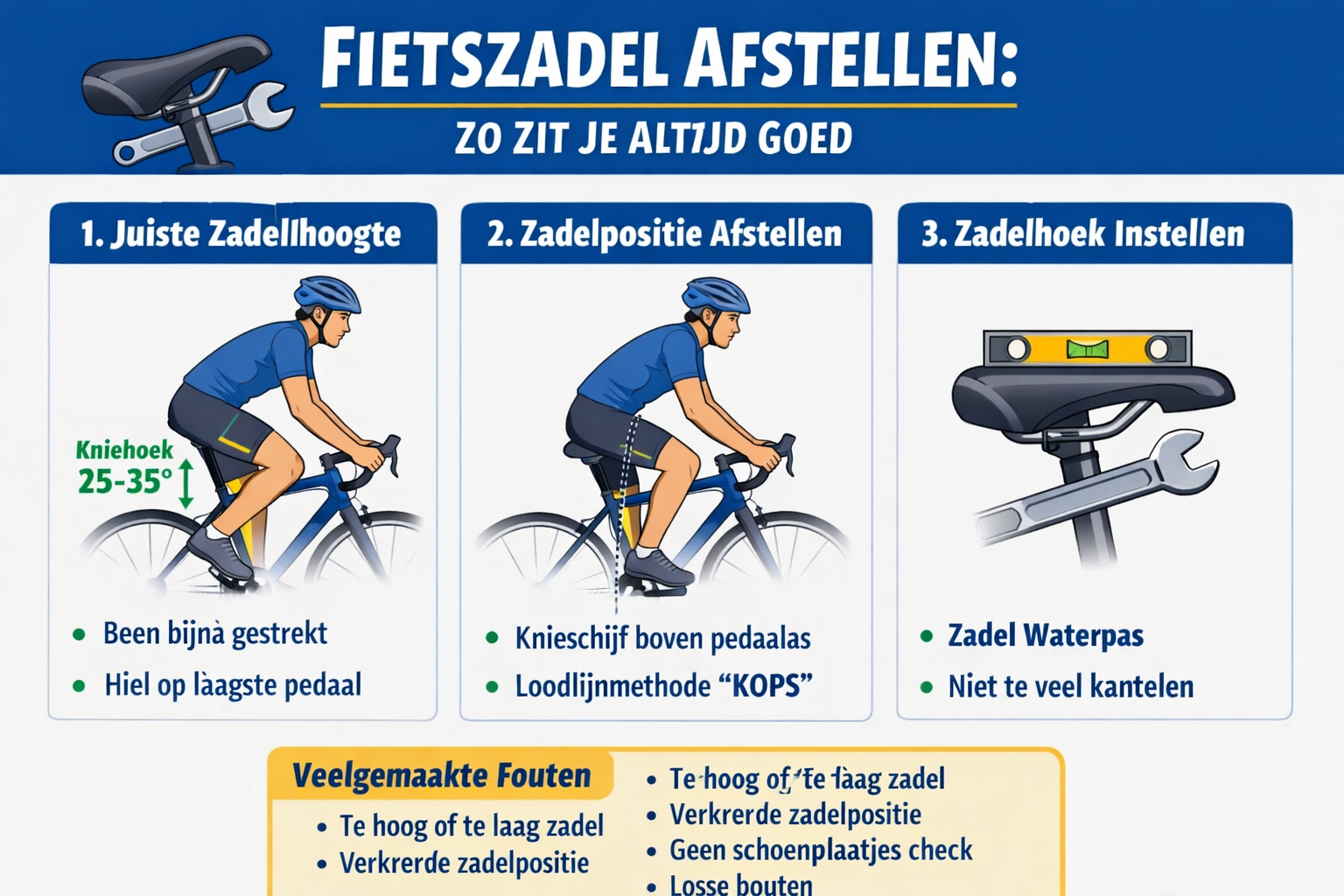
Bike saddle adjustment gives you optimal power transfer. Your legs move more efficiently and your knees stay within a safe range of motion. A wrong setting often causes overload of the kneecap or hamstrings.
Comfort also plays a big role. Pressure points on the seat often appear because the saddle sits too far forward or back. The tilt angle also affects how pressure spreads.
Want to know more about ergonomics on the bike? Then also read the information from the Fietsersbond, the Dutch cyclists’ union, on a healthy riding position.
Bike saddle adjustment: finding the right saddle height
Saddle height is the most important setting. A practical guideline:
- Sit on the bike.
- Put your heel on the pedal in its lowest position.
- Your leg should then be fully straight.
- When you pedal with the ball of your foot, you get a slight bend in the knee.
Professional bike fitters often work with a knee angle of about 25–35 degrees at the bottom of the pedal stroke. Professional bike fitting methods, such as those described by Bikefitting.com, also use this.
Saddle too high:
- Hips rock while cycling
- Pain at the back of the knee
Saddle too low:
- Pressure on the kneecap
- Reduced pedalling power
Adjusting the saddle forward or back
The horizontal position affects your knee line and balance.
Use this method:
- Set the pedals horizontal.
- Drop an imaginary plumb line down from your kneecap.
- The line should run roughly through the pedal axle.
This principle is known as the “KOPS” method (Knee Over Pedal Spindle). Although it is a good starting point, your personal body build stays decisive.
Setting the right tilt angle
Most saddles ideally sit level.
- If you like, use a small spirit level.
- Do not tilt the saddle too far forward; this puts pressure on hands and shoulders.
- Do not tilt the saddle too far back; this increases pressure on the seat.
With specific saddles, such as models with a cut-out or short nose, a slight forward tilt can be more comfortable.
Extra attention to bike saddle adjustment on e-bikes
On e-bikes, the riding position is often more upright. As a result, pressure distribution changes. A slightly wider saddle can give more support. Stability is also important, especially at higher speeds.
On electric bikes, look out for:
- Extra load from battery weight
- Comfort on longer rides
- Correct setup in combination with handlebar height
You can find more information on cycling safely with electric bikes via Veilig Verkeer Nederland, the Dutch road safety organisation.
Common mistakes in bike saddle adjustment
- Looking only at comfort and not at knee angle
- Not allowing for cleats (with SPD)
- Adjusting the saddle without checking handlebar position
- Not tightening bolts properly
In doubt? Then a professional bike fit can be a good investment.
After this look at bike saddle adjustment, some practical questions often remain. Below, we answer the most common ones.
Frequently asked questions about bike saddle adjustment
How do I know if my bike saddle is too high?
Your saddle is too high if your hips move from side to side while cycling. This points to overextension of the leg. You often feel pain at the back of the knee too. Check that your knee stays slightly bent when you press the pedal down to its lowest position with the ball of your foot.
What is the ideal knee angle when cycling?
The ideal knee angle is between 25 and 35 degrees at the bottom of the pedal stroke. This angle gives efficient power transfer without overloading the knee. Professional bike fitters use measuring equipment to find it precisely, but a visual check already gets you far.
Should a bike saddle be perfectly level?
Yes, in most cases a bike saddle sits level for the best pressure distribution. A slight deviation can be more comfortable with specific saddles, but an extreme tilt causes problems in hands, shoulders or lower back.
Do cleats affect saddle height?
Yes, cleats affect your effective leg length. When you switch to SPD pedals, you need to check your saddle height again. The sole thickness and position of the cleat directly affect your knee angle.


