Bike Technician Shortage Calls for Investing in Students
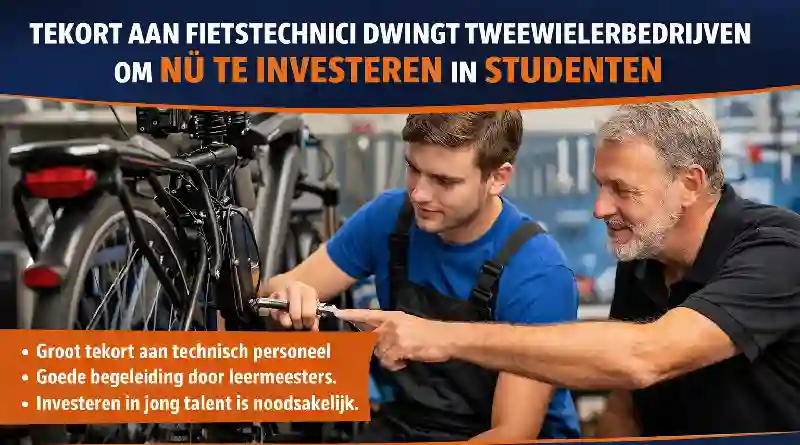
At bike companies in the Netherlands, the bike technician shortage is still large, while the amount of work in workshops keeps growing because of the rise of e-bikes, cargo bikes and other modern mobility solutions.
At the same time, many experienced mechanics will retire in the coming years, so knowledge and experience risk disappearing and the pressure on the remaining staff keeps rising.
That is exactly why investing in students is no longer a choice but a necessity for companies that want to survive in the long term.
Attracting and keeping young talent takes more than a place to learn, because above all good guidance from an experienced mentor decides whether a student develops or drops out early.
The Bike Technician Shortage Is Here to Stay
The bike trade has changed a lot in recent years, and the traditional bike increasingly gives way to electric versions with complex drive systems, software and battery technology.
These developments create extra work in the workshop and call for mechanics with specialist knowledge, while the supply of new bike technicians lags behind.
According to OOMT, many business owners see every day how hard it is to find suitable staff, even when they are actively looking and are willing to invest in training and guidance.
The bike technician shortage is therefore not a temporary problem but a structural challenge that almost every bike company faces.
Students Are Essential for the Future of the Workshop
BBL work-study students are an important link in solving the staff shortage, because they combine learning and working and so add value to the company during their training.
Still, not all bike companies take on students, because in practice they run into various obstacles that make guiding young talent complicated.
Smaller companies, for example, do not always have enough physical space for an extra workstation, or do not have several experienced mechanics who can offer guidance.
Larger companies often do have those facilities, but lack time and attention because of a full schedule and high workload in the workshop.
Guidance for Students Often Falls Short
According to BBL adviser Rob den Boef, a clear tension arises here: companies are crying out for staff, but struggle to create the right conditions for good guidance.
Guiding a student takes time, energy and attention, and those resources are scarce in a sector where every mechanic is badly needed to get the daily work done.
Yet in practice, students who get too little guidance often quit early, not because they dislike the trade, but because they do not feel taken seriously.
This rarely happens on purpose. It is usually the result of time pressure, unclear agreements and a lack of structure within the training company.
Students Drop Out Without Attention and Structure
Many bike companies lose students at an early stage, because they only get to do simple jobs or mainly have to watch, without getting real responsibility.
For young people this is demotivating, especially when they start their course with enthusiasm and expect to learn the trade in practice.
When students share these experiences with classmates or on social networks, a negative image of the company quickly forms, which makes attracting new talent even harder.
A training company must therefore not only be formally recognised, but also show that it really takes investing in students seriously.
Being a Training Company Takes Preparation and Vision
A bike company does not simply become a training company, because behind it lies a deliberate choice to help train new bike technicians.
That choice calls for preparation, clear agreements and a vision of what you want to achieve with a student as a company.
Even before a student starts, it is important to think about learning goals, guidance and communication, so that both the student and the team know what is expected.
This avoids confusion and gives a better start, which greatly raises the chance of success.
An Action Plan Makes Guidance Concrete
Drawing up an action plan for guiding students helps to create structure and makes guidance practical within the daily work.
Such a plan states who the regular mentor is, which tasks the student gets and how often you hold review meetings.
By briefly discussing progress every week, for example, you make room for questions, feedback and adjustments, without it costing much extra time.
Good communication prevents frustration and makes sure problems are spotted early.
Pay Attention to Generational Differences in the Workshop: Bike Technician Shortage
In many workshops, several generations work together, which can lead to misunderstandings about communication and expectations.
Younger students look differently at work, learning and feedback than experienced mechanics who have been in the trade for years.
By paying conscious attention to this, for example through internal conversations or workshops, you create more understanding and better teamwork.
This benefits not only the student, but also lifts the mood and efficiency in the workshop.
Students Want Prospects and Challenge bike technician shortage
A student does not choose bike engineering just to watch or do simple tasks, but wants to grow, learn and build a future in the trade.
By explaining to students what career opportunities there are and which technical challenges the trade offers, you raise their motivation and commitment.
The electrification of bikes, with complex drives and diagnostic systems, makes the trade attractive for young people who are interested in technology and innovation.
Training Is Essential in a Tight Labour Market: Bike Technician Shortage
In a labour market where good bike technicians are scarce, training your own is the most sustainable solution for bike companies.
BBL students who get good guidance grow into loyal employees who know the company and fit its way of working and culture.
That makes the investment in guidance not only necessary, but also profitable in the long term.
Financial Support via the Practical Learning Subsidy
Many business owners do not realise they can use the practical learning subsidy scheme (subsidie praktijkleren), which covers part of the guidance costs.
This financial support lowers the barrier to taking on students and makes investing in training more concrete and clear.
By showing what these funds are spent on, the conversation within the company shifts from costs and lost time to growth and future-proofing.
From BBL Student to Full Colleague
A motivated BBL student who gets the right guidance quickly develops into a full colleague who can work independently and take responsibility.
In a market with a structural bike technician shortage, that is an investment that pays back on several levels.


