Taking Your Child on the Bike: Safety and Tips
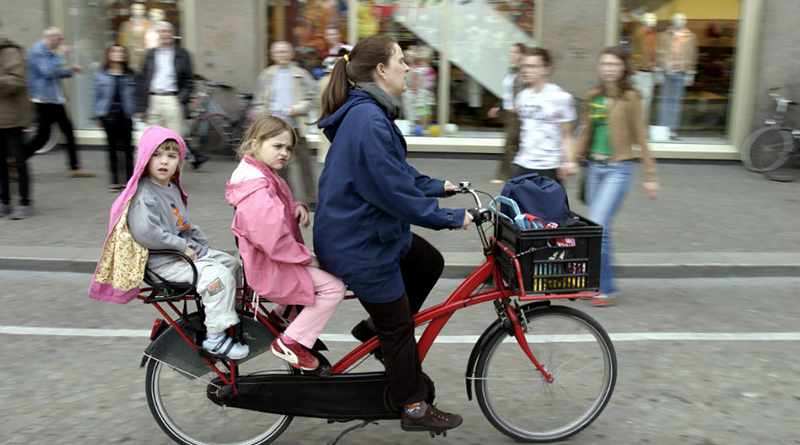
As a parent, you can hardly avoid it: taking your child on the bike. While they are still too small to cycle themselves, there are several ways to carry them safely, such as a child bike seat at the back, a seat at the front, or other methods. Here you can read what is safe and what to watch for.
Rear Child Bike Seat
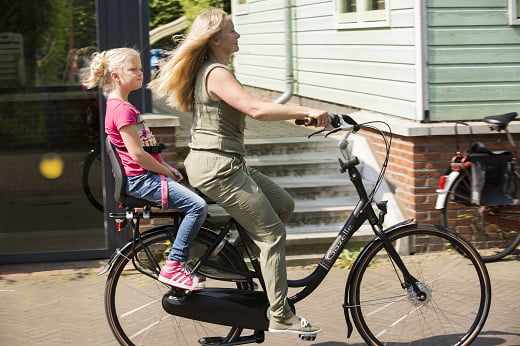 Children up to about five years old who can sit up on their own can ride in a rear seat. This is also the most common way to carry children. Note that the feet of children on the back are close to the turning wheel. So make sure you have good spoke guards.
Safety Tips for a Rear Seat
- Standard: Buy a child bike seat that meets the European standard (NEN-EN 14344).
- Spoke guard: Use a hard plastic guard fitted between the footrest and the wheel. A coat guard is not a foot guard.
- Try the seat: Check that your child’s feet cannot get between the spokes. Fit the spoke guard with room to grow and check it regularly.
- Foot straps: A child seat with foot straps is not enough, because foot straps do not always protect against spoke injuries.
- Mounting: A seat mounted on the luggage carrier needs extra fixing to the frame.
- Saddle spring guard: Fit a saddle spring guard to stop little fingers getting trapped.
- Correct fitting: Make sure the rear seat is fitted in the right place. Too far forward, for example, limits the child’s space. Too far back gives a risk of tipping.
- Belt fastened: Fasten the belt for extra support, especially with young children.
Front Child Bike Seat
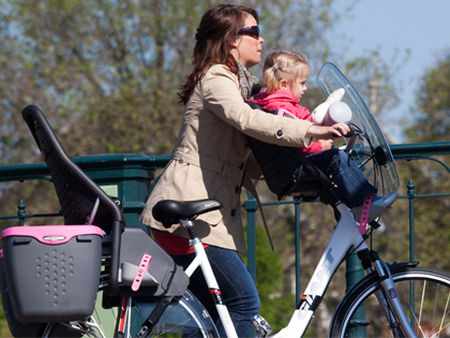 As soon as your child can sit up from a crawling position on their own, usually between 9 and 12 months, they can ride in a seat at the front. The front seat suits children up to about three years old. Also watch out that steering does not get too heavy as your child grows.
Safety Tips for a Front Seat
- Standard: Buy a child bike seat that meets the European standard (NEN-EN 14344).
- Mounting: Fix the seat to the stem or head tube (not suitable for aluminium handlebars).
- Not a road bike: Do not fit a front seat on a road bike.
- Cables: Make sure the brake and gear cables do not get trapped.
- Try the seat: Check that your child’s feet cannot get between the spokes.
- Check body parts: Make sure no body parts get trapped when you steer.
Usage Tips for a Front Seat
- Never leave your bike on its stand with your child on it.
- Make sure the bike does not fall over while your child climbs on or while you lift them on.
- Load the shopping first and your child last.
- Allow for the extra weight on the bike (slower reaction when braking and pulling away).
- Make sure your child cannot block the wheel (by fastening the lock).
Double Child Bike Seat
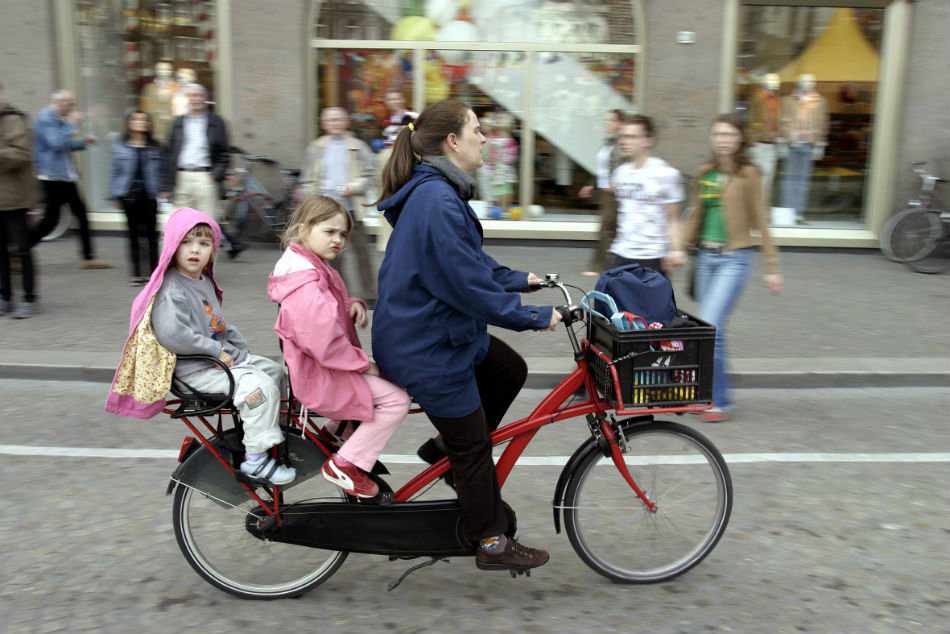 For several children, you can fit a double seat in place of the luggage carrier. These seats suit children from about four years old. Watch out for feet getting into the spokes.
Safety Tips for a Double Seat
- Spoke guard: Use a hard plastic guard between the footrest and the wheel. A coat guard is not a foot guard.
- Try the seat: Check that your child’s feet cannot get between the spokes. Check regularly and fit the spoke guard with room to grow.
- Footrests: Footrests with foot straps are not enough.
- Risk of tipping: Watch out for tipping when you get off, especially because the seat sticks out behind the rear wheel axle.
- Steering: The bike steers less well because of the weight at the back.
Saddle on the Crossbar
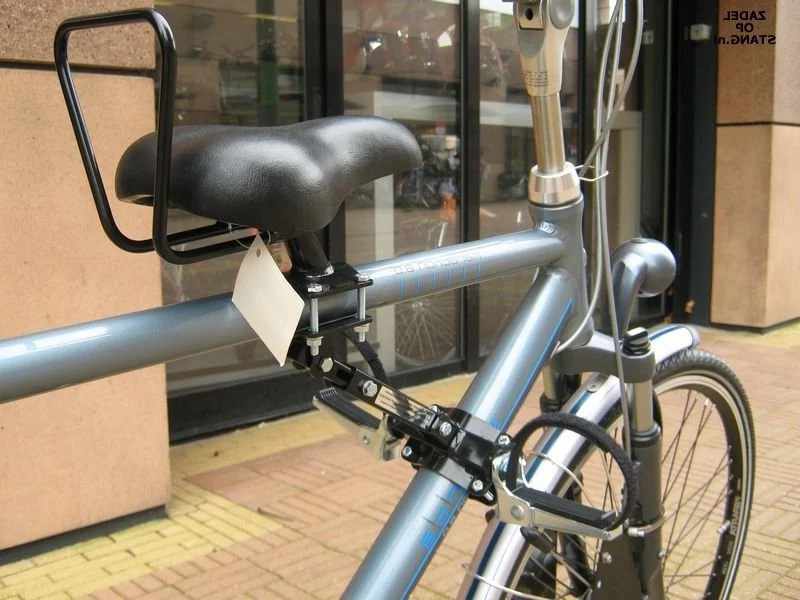 If your child gets too heavy for a seat on the handlebars, you can fit a small saddle on the crossbar. This is also a good alternative for calm children from 3-4 years old up to about 6-7.
Safety Tips for a Saddle on the Crossbar
- Spoke guard: Use a hard plastic guard between the footrest and the wheel.
- Try the seat: Check that your child’s feet cannot get between the spokes. Check regularly and fit the spoke guard with room to grow.
- Footrests: Footrests with foot straps are not enough.
- Correct fitting: Make sure the little saddle is fitted in the right place.
- Check body parts: Check that your child’s feet and legs do not get trapped when you steer.
- Note: Keep your child busy and talk while cycling, especially when braking, in sharp bends or over bumps.
Baby on the Bike
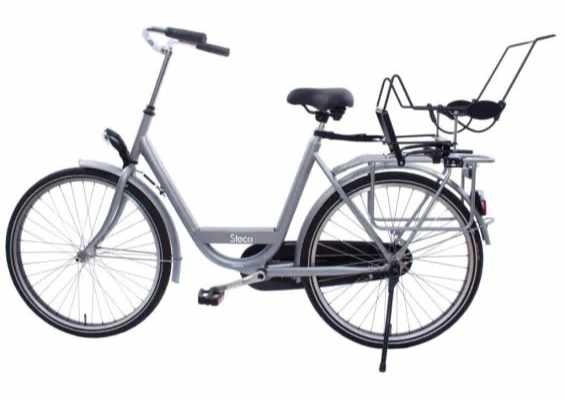 You can carry young babies on a bike safely in a few ways, although there are always risks.
Safe Ways to Carry a Baby
- Baby car seat or infant carrier: Fix it firmly in a bike trailer or cargo bike. Preferably place the seat facing backwards.
- Car seat on the bike: Fixed to the bike with a special carrier.
- Harnesses: Always strap the baby in with harnesses.
- Comfort: Make sure the baby feels comfortable and avoid vibrations and shocks.
- Short trips: Do not ride far at first, and choose routes with few bumps.
Unsafe Ways to Carry a Baby
- Baby carrier: A carrier with the baby hanging on the rider’s stomach or chest is not safe. Also, it gives no protection in a fall.
Minimum Age
There is no single minimum age for babies on a bike. So until your child can hold their head up on their own, it is probably better not to carry them by bike. First, start with short trips on an even surface.
Extra Buying and Usage Tips
- Step-through bike/City bike/Cargo bike: Use a bike whose saddle is not too high.
- Brakes: Make sure you have good brakes and do not ride too fast.
- Mounting: Make sure the car seat or infant carrier is fixed well.
- Adjustable suspension: With a bike trailer or cargo bike, make sure the suspension is good.
- Build-up: Build up carrying small children by bike gradually with short rides.
Cycling safely with your child takes the right preparation and care. With the right seats, spoke guards and other precautions, you can enjoy bike rides with your little one.


