Cycling Backpack vs Pannier: Which Is the Best Choice?
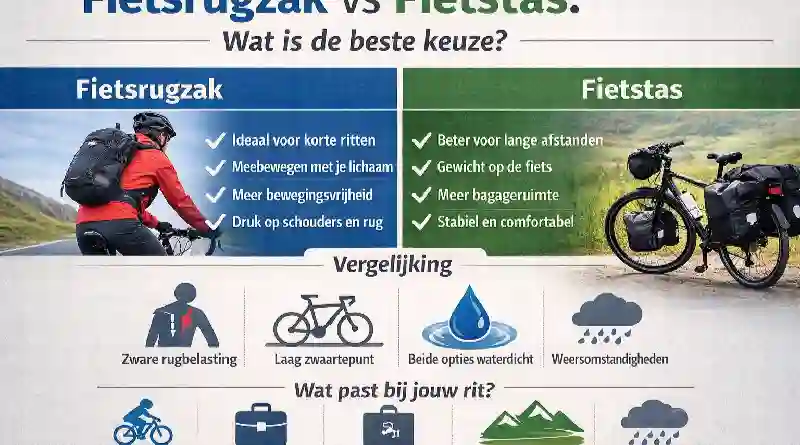
The choice between a cycling backpack and a pannier depends on how you use it, the distance and your comfort needs. In the cycling backpack vs pannier debate, both options have clear advantages, but also limits. Someone who cycles to work every day has different needs from a touring cyclist or a sporty mountain biker. If you look closely at weight, ventilation, stability and ease of use, you make a choice that fits your type of ride.
When do you choose a cycling backpack?
You wear a cycling backpack on your back and it moves with your body. That makes it popular with sporty cyclists and commuters who want flexibility.
A cycling backpack is ideal when:
- you have no luggage rack
- short to medium distances
- sporty riding (road bike, gravel bike, MTB)
- a need to hop off quickly and walk on
Models from Osprey and Deuter, for example, come with ventilation panels and ergonomic carrying systems. This prevents excess sweating and spreads the weight better over shoulders and hips.
However, there are downsides. All the weight rests on your body, which can strain your neck and lower back on longer rides. A full backpack can also limit your freedom of movement.
When do you choose a pannier?
You attach a pannier to your luggage rack. As a result, the weight of your luggage stays on the bike and not on your body.
In the cycling backpack vs pannier choice, a pannier suits you when:
- longer distances
- heavy items to carry (laptop, shopping)
- you use an e-bike or city bike
- comfort is a priority
Brands such as Ortlieb and Basil are known for waterproof materials and secure mounting systems. For commuting or cycling holidays in particular, a double pannier or a single rear pannier is the more ergonomic choice.
One point to watch is stability. Cheap mounting systems can rattle or shift. So choose a click or hook system with a lock.
Comfort and ergonomics compared
In ergonomics, one main rule applies: the longer and heavier the ride, the more important weight distribution becomes.
A cycling backpack:
- raises your centre of gravity
- strains shoulders and back
- gives more freedom of movement
A pannier:
- lowers the centre of gravity
- relieves the body
- can make the bike a little wider
For e-bike riders, a pannier is usually the best choice, because speed and extra weight call for stable weight distribution.
Waterproofing and protection
Both options come in waterproof versions. With panniers, look for welded seams and a roll-top closure. With backpacks, a built-in rain cover is often enough, unless you cycle in heavy rain every day.
For laptop use, a padded compartment is essential, whichever you choose.
What is the best choice in the cycling backpack vs pannier debate?
There is no universal best option. Sporty cyclists and minimalists often choose a cycling backpack. Commuters, e-bike riders and touring cyclists usually benefit more from a pannier.
So analyse:
- distance per ride
- total weight
- type of bike
- weather conditions
- comfort needs
A considered choice prevents physical complaints and adds a lot to your cycling enjoyment.
After this comparison, some practical questions often remain. Below, we answer the most common ones.
Frequently asked questions about backpacks and pannier
Is a cycling backpack bad for your back?
Not necessarily. A cycling backpack is safe when you use it correctly and keep the weight limited. On long rides or with heavy loads, however, strain on neck and shoulders can build up. Choose a model with a hip belt and ventilation system to spread pressure better and prevent overheating.
What is better for commuting?
For commuting, a pannier is usually more comfortable. The weight rests on the bike instead of on your body, which is especially nice with laptops and documents. In addition, many panniers are fully waterproof, which protects your things in wet weather.
Can I use a pannier without a luggage rack?
No, a standard pannier needs a luggage rack. Some sporty saddle bags or frame bags are an alternative, but they hold less. Without a rack, a cycling backpack is often the most practical solution.
Is a cycling backpack warmer in summer?
Yes, a cycling backpack can feel warmer in summer because it sits against your back. Ventilation channels and mesh back panels reduce this effect, but full ventilation as with a pannier is not possible.


