Fatbike Ban in Enschede: Wardens Enforce It, Police Do Not
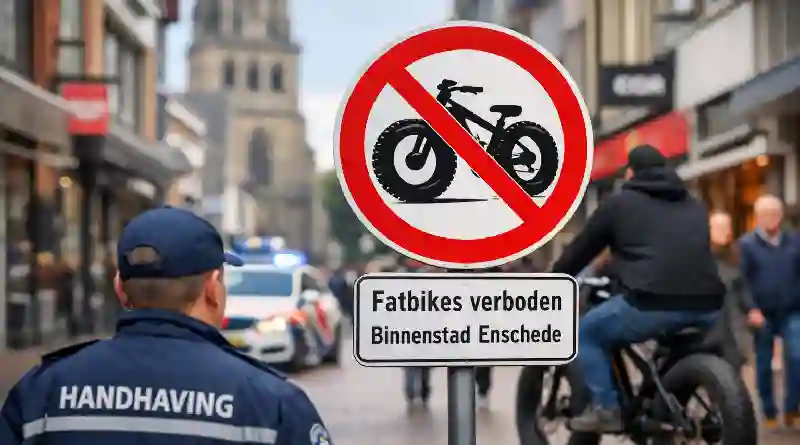
Since Wednesday 11 March 2026, Enschede has been the first Dutch municipality with a specific fatbike ban in the city centre during shop opening hours. Riders of an electric bike with tyres wider than 7 centimetres risk a fine of 115 euros there in the end. For the first two weeks, the municipality is still giving warnings. Strikingly, the police do not enforce the ban and the Public Prosecution Service (OM) does not want to prosecute offenders, while municipal enforcement officers (boa’s) do step in. This has suddenly started a national debate on road safety, local powers and the legal strength of separate rules for fatbikes.
The Enschede measure is mainly meant to reduce nuisance in the busy shopping area. According to the municipality, fatbike riders regularly speed through the centre, sometimes in groups and sometimes doing stunts. The city council says this creates unsafe and intimidating situations for shoppers, pedestrians and other cyclists. The municipality has therefore changed its local bylaws (APV) and deliberately chose a measure limited by time and place instead of a general ban for the whole city. Enschede sees that limited scope as legally defensible.
At the same time, this situation shows how complicated the fatbike issue has become. Where a municipality wants to take a local measure for public order and safety, the Public Prosecution Service looks mainly at the national legal basis. According to the justice authorities, it is hard to ban fatbikes separately, because the Road Traffic Act puts them in the same category as other electric bikes with pedal assistance. This leads to a remarkable situation: if you ride a fatbike in the ban area in Enschede, you need not expect a fine from a police officer, but you might get one from an enforcement officer.
Why Enschede Is Introducing a Fatbike Ban
The core of the measure is not that every fatbike is banned as such, but that the municipality wants to keep one specific type of vehicle out of the busiest part of the city centre when most pedestrians are there. This fits a broader trend in local government, where municipalities increasingly try to regulate traffic flows differently in places where many people gather. Think of shopping streets, parks and station areas. In such areas, speed is not the only thing that matters. People’s sense of safety also counts, as does how far vehicles seem threatening because of their size and look.
Fatbikes play a special role here. They stand out for their wide tyres, fairly robust build and the link with higher speeds, tuning and stunt riding. Not every fatbike rider causes nuisance, but the image of these bikes has got much worse in recent years. Municipalities see this in reports from residents, businesses and visitors. Enschede has turned those signals into a concrete local ban that applies only to the shopping area during opening hours. In this way, the city tries to balance accessibility and safety without introducing a total ban straight away.
What makes the debate extra interesting is that Enschede is leading the way. Other municipalities are watching, and according to earlier statements by the Enschede alderman, there is a lot of interest from other cities. Amsterdam too has now chosen to allow a fatbike ban in certain busy places through its local bylaws, although it still has to work out exactly where and when this will apply. This makes Enschede look less like an exception and more like a test case for local fatbike policy in the Netherlands.
Police Do Not Enforce the Fatbike Ban in Enschede, Enforcement Officers Do
The most discussed part of the Enschede decision is enforcement. In theory, there is a ban and a fine for breaking it. In practice, though, two enforcement parties take different lines. The police do not step in, because the Public Prosecution Service finds the ban legally weak. The municipality, on the other hand, says it trusts the measure and lets enforcement officers check. This creates an unusual situation in which the way the rule works in practice depends on who spots the offence.
This is confusing for residents and visitors. When people see a traffic rule, they usually expect it to apply in the same way for all enforcers. Now there seems to be a hybrid situation in which the local government sets a norm, but the criminal-law line of the police and the Public Prosecution Service does not fully follow it. Legally, that is tricky, but in terms of governance it is also risky. If rules are not explained or enforced in the same way everywhere, that can damage the credibility of policy.
Even so, Enschede also shows something else: municipalities no longer want to wait until The Hague comes up with a fully worked-out national framework. They already see nuisance in public spaces and so look for tools within their own powers. Enforcement officers are a logical tool here, because they often enforce local bylaws. From a municipal point of view, this is less strange than it first seems. The conflict is mainly between local customisation and national traffic law.
Legally Weak or Cleverly Defined?
The legal debate turns on one main question: can you treat fatbikes separately if national law does not recognise them as a separate vehicle category? According to the national government, it is hard to make specific rules only for fatbikes. The cabinet has now said that separate rules for fatbikes and other e-bikes are unworkable, partly because manufacturers can quickly change their vehicles, because enforcement is complicated and because there is no hard evidence that a fatbike is more dangerous in itself than another e-bike. For this reason, the national government is now looking more widely at measures for minors on fatbikes, e-bikes and other light electric vehicles, instead of only at a fatbike ban like the one in Enschede.
This national position seems to support the criticism by the Public Prosecution Service and the police in Enschede in part. At the same time, Enschede takes a different route. The city does not say: fatbikes are banned everywhere as a vehicle type. It says: in a specific shopping area, at specific times, riding an electric bike with tyres wider than 7 centimetres is not allowed. That is a different legal construction. What matters is not the vehicle category in the national sense, but the local public space and the regulation of behaviour within it.
Whether that holds up will depend on objection procedures, possible fines and court review. Until then, Enschede remains a test case. If the measure stands, other municipalities get a usable model. If it falls, the pressure for national legislation grows even more. In both scenarios, Enschede has sped up the debate.
Skinnybike as an Alternative and a Possible Workaround
As if the debate were not complex enough, the market is already pointing to a new phenomenon: the skinnybike. According to a seller quoted in the NOS article, it is a kind of fatbike with thinner tyres. This would keep a similar look or riding experience, while the bike might fall outside the Enschede definition. That shows exactly why national bodies are wary of rules that lean heavily on outward features or specific technical properties.
When rules are worded too narrowly, manufacturers and sellers get room to design the product slightly differently. We see this in more sectors where technology and regulation follow each other quickly. For municipalities, that is a tricky field. They cannot rewrite their bylaws every month because a new variant reaches the market. Enschede also admits this problem and says it will keep assessing new variants and consider extra rules where needed.
For consumers, this does not make things clearer. After all, when is a bike still a fatbike, when is it an e-bike with wide tyres and when is it an alternative model that falls outside a local ban? Without clear national definitions, this grey area remains. That is exactly why manufacturers, enforcers, sellers and municipalities can look differently at the same bike.
Is a Fatbike Ban Like Enschede’s the Best Solution?
The question is of course whether a ban in a city centre is the best way to tackle the problem. Supporters point to direct gains in busy shopping areas. Fewer fast, heavy e-bikes among pedestrians means, in theory, less nuisance and less risk of dangerous situations. In historic city centres with narrow passages, terraces and many shoppers in particular, this is easy to defend.
Opponents find the ban too specific and too symbolic. They point out that ordinary e-bikes can also ride at 25 km/h and that dangerous behaviour is not limited to fatbikes. That argument also comes back in the debate on national measures. The national government is now looking at wider rules for electric bikes and other light electric vehicles, partly because fatbikes are hard to define sharply.
From a traffic-engineering view, that is a logical point. The real problem is often not just the type of vehicle, but the mix of speed, mass, riding behaviour, the rider’s age, tuning and use in busy areas. A narrow e-bike that rides too fast among pedestrians can be just as dangerous. At the same time, local policy can certainly make sense if it responds to recognisable practical problems. After all, a municipality does not have to solve every national issue completely to have a local effect.
The future is therefore likely to lie not in one measure, but in a mix. Think of targeted bans in busy places, stricter checks on tuned e-bikes, age or helmet rules for young people and clear national definitions for enforcement. Above all, Enschede shows that local governments do not want to wait until every legal detail is nailed down nationally.
What Does This Mean for Other Municipalities and Cyclists?
For other municipalities, Enschede is mainly a pilot. The city is testing whether a local fatbike policy through the bylaws is workable and defensible. Amsterdam has already taken a step in that direction by making room for fatbike bans in busy places. If more municipalities follow, a patchwork of local rules appears. That makes it harder for cyclists to know what is still allowed where.
For the bike industry, this again means uncertainty. Sellers must be able to explain to customers which models are still welcome in city centres and which are not. For consumers, the choice gets more complicated, especially when local definitions differ. Manufacturers and importers, meanwhile, have an extra reason to develop new variants that fall inside or just outside certain rules.
For cyclists themselves, the main lesson for now is simple: check the local rules of the municipality where you ride. In Enschede, electric bikes with tyres wider than 7 centimetres can now be kept out of the designated centre area during shop opening hours, with a fine of 115 euros after the warning period. If you think national unclarity automatically means no local enforcement, an enforcement officer may still surprise you.
For extra context and reliability, you can also refer in the article to information from the national government on planned rules for e-bikes and fatbikes, and to VeiligheidNL for figures and background on accidents involving young riders. Both sources strengthen the content without being commercial.
After looking at the fatbike ban in Enschede, a few practical questions often remain. Below, we answer the most common ones.
Frequently Asked Questions About the Fatbike Ban in Enschede
Does the fatbike ban apply to the whole of Enschede?
No, the ban does not apply to the whole of Enschede. The measure is limited to the shopping area in the city centre and only during shop opening hours. The municipality uses this limit by time and place as support for the legal strength of the rule.
Do you always get a fine if you ride a fatbike through the centre of Enschede?
No, in the first two weeks after introduction, it stays with warnings. After that, a fine of 115 euros may follow. There is a difference in enforcement, though: the police do not enforce, but the municipality’s enforcement officers do. So in practice, enforcement can depend on who is checking.
Why do the police not enforce the fatbike ban?
The police do not enforce it because the Public Prosecution Service finds it legally difficult to treat fatbikes separately under current traffic law. On this line, fatbikes and other electric bikes with pedal assistance fall into the same category, which makes separate criminal enforcement weak.
What is a fatbike according to Enschede?
In Enschede, the ban covers bikes with an electric assist motor and tyres wider than 7 centimetres. This definition matches the local bylaw drawn up for the centre. New variants with narrower tyres might therefore fall outside this specific definition.
Will there be national rules for fatbikes?
The government is working on national measures, but the focus is now wider than fatbikes alone. In 2027, the national government wants to introduce a helmet requirement for minors riding fatbikes, e-bikes and other light electric vehicles. The cabinet also says separate rules for fatbikes alone are hard to put into practice.


