How to Choose a Bike Groupset: A Practical Guide
What Is a Bike Groupset and Why Does It Matter?
A bike groupset is the set of parts responsible for driving, shifting and braking your bike. Think of the chain, cassette, derailleur, crankset, shifters and brakes. Choosing the right groupset largely decides how smoothly you ride, how reliable your bike is and how much maintenance it needs.
A good groupset means efficient shifting, less wear and a pleasant ride. If you ride regularly or have specific goals such as sporty riding, commuting or long tours, it is essential to look at this carefully. You notice the difference between an entry-level and a high-end groupset straight away in performance and durability.
What Types of Groupsets Are There?
Mechanical vs. Electronic Groupsets
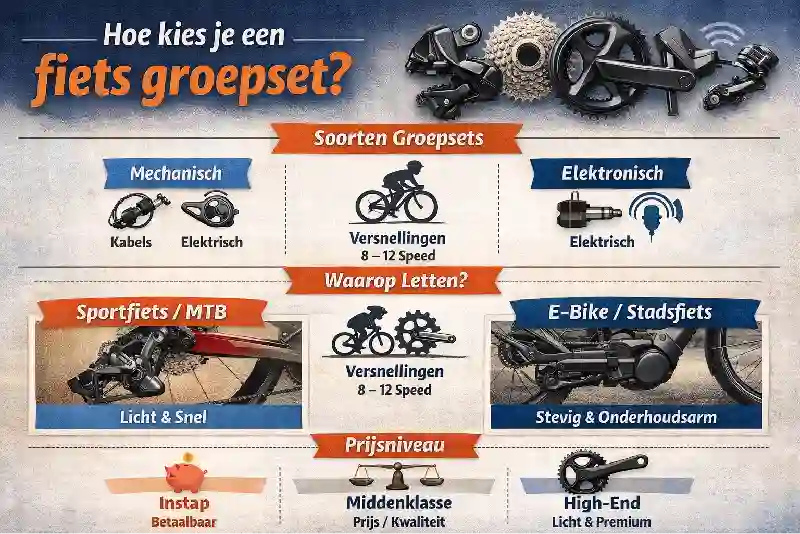
Mechanical groupsets work with cables and are still the most widely used. They are reliable, fairly easy to maintain and often cheaper. Electronic groupsets, on the other hand, shift using electrical signals. This gives extremely precise and fast shifting, but it needs a bigger budget and batteries that you have to charge.
Well-Known Brands and Series
The best-known brands are Shimano, SRAM and Campagnolo. Within these brands, there are several levels:
- Entry level: Shimano Tourney, SRAM X3
- Mid-range: Shimano Deore, Shimano 105
- High end: Shimano Ultegra, SRAM Force, Campagnolo Chorus
As a result, the higher the series, the lighter, more durable and more precise it works.
What to Look for When Choosing a Bike Groupset
1. What You Use Your Bike For
The most important factor is how you will use the bike:
- Sport bike (road bike/MTB): lightweight and fast shifting
- E-bike: strong and durable parts
- City bike: low maintenance and reliable
For sporty riders, weight and performance matter, but for daily use, durability and simplicity weigh more.
2. Number of Gears
Groupsets differ in the number of gears (for example 8, 10, 11 or 12 speed). Also, more gears mean smaller steps between the sprockets and so smoother shifting. For leisure use, fewer is often enough, while sporty cyclists benefit from more gears.
3. Weight vs. Durability
Lighter groupsets are often made of more expensive materials such as carbon and aluminium. They are ideal for speed and performance, but can wear faster with intensive use. However, heavier groupsets are more robust and better suited to daily use or e-bikes.
Different Uses Explained
Sporty Cycling (Road and MTB)
For sporty cyclists, it is all about performance. Here you usually choose a light bike groupset with many gears. Think of fast shifts, minimal resistance and low weight.
E-Bike and Daily Use
On e-bikes and city bikes, the focus is on durability. Because the motor adds load, parts wear faster, so you choose sturdy components and possibly a hub gear.
Maintenance and Lifespan
A more expensive groupset does not always mean less maintenance, but it often means better performance. Cleaning, lubricating and adjusting regularly extends its life considerably. For daily use, a low-maintenance option such as a hub gear or belt drive can be interesting.
Budget and Value for Money
Groupsets vary a lot in price. Entry-level models are fine for beginners and leisure use. The mid-range offers the best balance between price and performance. High-end groupsets are mainly interesting for keen cyclists who want the most from their ride.
It is wise to invest in a bike groupset that suits your use. Besides, overspending makes little sense if you do not use the performance, while a groupset that is too cheap can lead to frustration and higher maintenance costs.
After looking at how to choose a bike groupset, a few practical questions often remain. Below, we answer the most common ones.
Frequently Asked Questions About Choosing a Bike Groupset
Which groupset is best for beginners?
The best groupset for beginners is an entry-level model from a reliable brand. It offers enough performance, is affordable and easy to maintain. Think of Shimano Tourney or Altus for leisure use.
Is a more expensive groupset always better?
No, a more expensive groupset is mainly better in performance and weight, but you do not always need it. For daily use, a mid-range groupset is often the best choice.
How many gears do I need?
For city use, 7 to 9 gears are usually enough. Sporty cyclists often choose 10 to 12 gears for more control and efficiency.
What is better: a derailleur or a hub gear?
A derailleur is lighter and more efficient, ideal for sporty use. By contrast, a hub gear is low-maintenance and better suited to daily use and e-bikes.
How long does a bike groupset last?
A groupset lasts a few thousand kilometres on average, depending on use and maintenance. Therefore, regular maintenance extends its life considerably.


