The Bike Drivetrain: How a Hub Gear Works
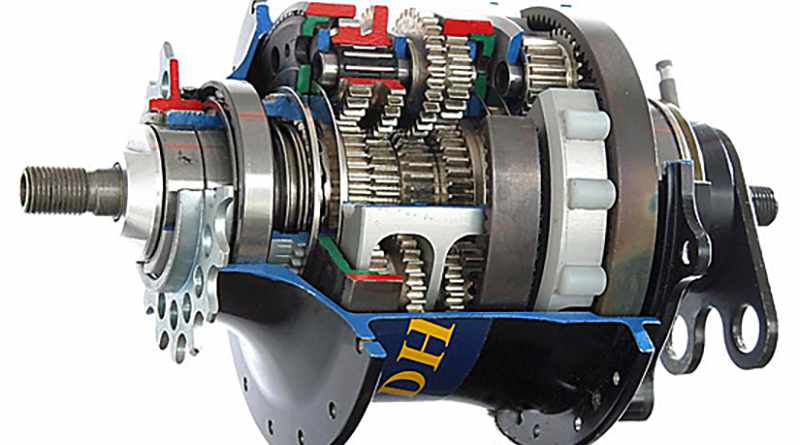
The hub gear is a popular alternative to the derailleur and has many benefits for cyclists. The mechanism is not directly visible. Still, it helps to understand how it works and why it can be an excellent choice for many cyclists. This article looks at how it works, its benefits and the options available.
What Is a Hub Gear?
A hub gear works with an ingenious system of gears known as a planetary gear mechanism. This mechanism, also called an epicyclic system, originally comes from watchmaking. Engineers also used it in steam engines as early as the 18th century. In the cycling world, the first use of a planetary gear set was in the Crypto bottom bracket for the penny-farthing in 1878, with two settings: direct drive and a higher gear. After the arrival of the chain drive, it found its way into the rear hub of bikes.
How Does a Hub Gear Work?
A planetary gear set consists of a sun gear, planet gears, a planet carrier and a ring gear. In a bike hub, the axle holds the sun gear, while the planet carrier and the ring gear turn inside the hub shell. By connecting the driver (the part the sprocket attaches to) to the planet carrier or the ring gear, you change the gear ratio.
- Lower gear: Connecting the driver to the ring gear and the planet carrier to the hub shell gives a reduction, so the sprocket turns more often than the hub shell.
- Higher gear: Connecting the driver to the planet carrier and the ring gear to the hub shell gives an overdrive.
- Direct drive: In a three-speed hub, there is also a direct drive option, where the driver connects straight to the hub shell.
Benefits of a Hub Gear
One of the biggest benefits of a hub gear is the straight chain line. The chain does not change position as it does with a derailleur. In addition, the gear system is sealed inside the hub, so dust and moisture cannot reach it and it always stays well lubricated. This means less maintenance and a longer life for the gear parts.
Another benefit is that you can change gear while the bike is standing still, which is especially handy at traffic lights or when you have to stop suddenly. You cannot do this with a derailleur, where you can only change gear while pedalling.
Gear Options
Hub gears come in different configurations, from 2 to 14 gears. The most common are the 3-, 5-, 7- and 8-speed hubs. For bikes with more than three gears, makers combine several planetary gear sets. The Rohloff Speedhub 500/14, for example, has as many as 14 gears.
There are also continuously variable systems, such as the Enviolo (formerly NuVinci), which use a traction drive instead of an epicyclic system.
Special Designs
Some hub designs combine the gear mechanism with other functions, such as a dynamo or brake. A good example is the classic cable-free Torpedo Duomatic two-speed hub, which shifts when you backpedal and brakes when you backpedal harder.
Range and Efficiency
The range of a hub is the ratio between the lowest and the highest gear. The larger the range, the more versatile you are when riding in different conditions.
A hub always loses some energy, because the drive passes through a number of meshing gears. These losses turn into heat. The smallest loss, around 2%, happens in direct drive. In other gears, losses range from 10 to 15%.
The Enviolo, because of its unique design, loses about 20%. This makes it less efficient than other systems. However, it works well on bikes with electric pedal assistance, where the motor makes up for the loss.
Conclusion
This system has many benefits, especially for cyclists who want a low-maintenance, easy-to-use gear system. It comes in different configurations and lets you change gear at a standstill. So it is an excellent choice for both daily commuters and leisure cyclists. The only thing to consider is the effect on efficiency. However, with modern designs and technology, these losses stay within acceptable limits.
For a deeper explanation of the hub, click here.


