Minister Van Nieuwenhuizen Wants Safer Traffic

Traffic Has Become Safer Again, With Few Accidents Caused by Cyclists Texting
The Fietsersbond, the Dutch cyclists’ union, welcomes Minister Van Nieuwenhuizen’s ambition for safer traffic. The Fietsersbond sees that traffic has been getting safer for cyclists in recent years, but that much room remains to improve safety for older cyclists in particular. 1 per cent of cycling accidents are caused by smartphones. So attention should go less to texting on the bike and more to better cycling infrastructure.
New Figures
Today the Ministry of Infrastructure and Water Management published the 2016 figures on road accidents. The underlying figures from the Foundation for Scientific Research on Road Safety (SWOV) show that cycling in the Netherlands has become even safer. The number of road deaths among cyclists did rise to 189. But that lagged behind the growth in cycling kilometres, so the risk fell. The risk fell mainly among younger cyclists. Cyclist deaths still occur mainly in accidents with motor vehicles.
Texting on the Bike
Phone use on the bike seems to be growing considerably and irritates other road users. However, there is little to no sign that it also leads to extra accidents. Both the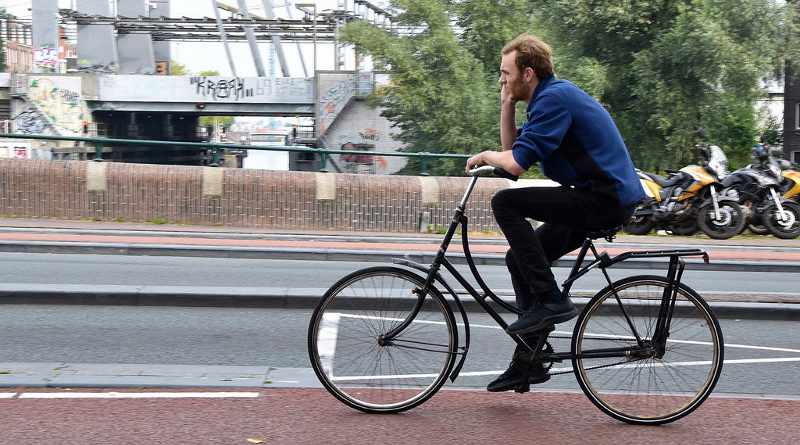 figures published today and the interim report on cycling accidents by veiligheid.nl show that phone use plays a relatively small role in road accidents. The phone seems to play a role in only 1% of cyclist accidents. This is unlike smartphone use in cars, which does contribute heavily to the number of accidents. Nevertheless, the Fietsersbond supports the Minister’s wish to ban texting on the bike, because this phone use does irritate other cyclists. The Fietsersbond calls for a mandatory mobility mode on every phone. “Using a smartphone in traffic is often dangerous, but not specifically for cyclists,” says Saskia Kluit, director of the Fietsersbond. “We need to solve this for all mobility.” The mobility mode is comparable to a phone’s flight mode. No new messages come in while the phone moves faster than walking pace. You can still use navigation.
Safer Traffic for Older Cyclists
More and more older people keep cycling until later in life. This is a clearly positive way for them to work on their health. Unfortunately, if they do get involved in an accident, they are more vulnerable. So we see an increase in the number of road deaths among cyclists aged 80 and over. Despite this rise, cycling has also become safer for them. To make it even safer for older cyclists, cycling policy needs a big step up. “To a large extent it is a demographic matter. The Netherlands is ageing. The share of over-80s is growing. There is also strong growth in cycling, including among over-80s. Today’s seniors are fitter and keep cycling for longer. They want to stay active. So there are more over-80s, and they cycle more than they used to. And because of all that cycling, they stay healthy for longer,” says Saskia Kluit, director of the Fietsersbond.
More Road Safety
Cycling is getting safer and gives a positive boost to cyclists’ health. Older people can cycle for so long and stay vital partly because cyclists in the Netherlands get space. Let us not lose sight of road safety, and keep working on better cycling infrastructure. Not because it is unsafe, but because it can be even safer and even better. A car is often involved in fatal cycling accidents. So you should separate car and bike traffic wherever possible. In addition, lowering the speed to 30 km/h is a good measure to cause fewer accidents. The accidents that do still happen will also be less serious.
Source: press release by the Fietsersbond


