Stacy Kohut: Mountain Biking in a Wheelchair?
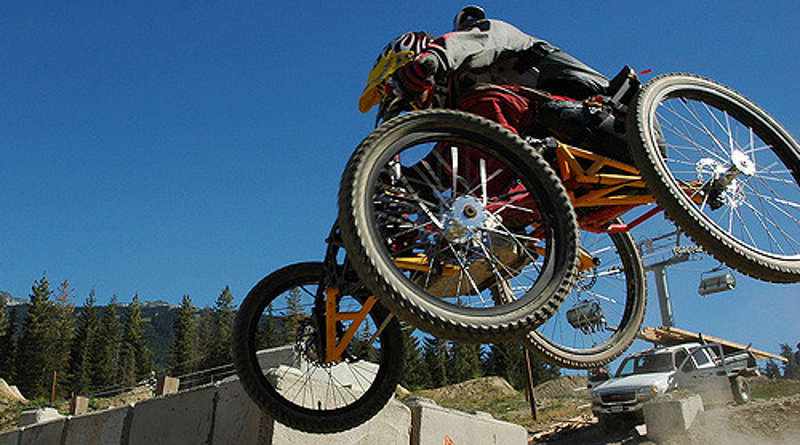
Stacy Kohut proves it can be done
For many athletes it is a nightmare: an accident that leaves you paralysed from the waist down. It usually means the end of a career as a top athlete. But for some, it is also the start of a new challenge. That is how it was for Stacy Kohut, who thought: if I can go downhill on a mountain bike, I can also do it on four wheels.
A new challenge
Stacy Kohut is an inspiration to many. His story begins with a serious injury that put him in a wheelchair. But instead of giving up, he decided to continue his passion for mountain biking, though in a different way. Kohut developed a special four-wheeled mountain bike. With it, he can tackle the most challenging trails.
Innovation in sports equipment
The four-wheeled mountain bike that Kohut uses is a technological marvel. These bikes are designed to give stability and control on rough terrain. They have suspension and shock absorbers similar to those on traditional mountain bikes, but adapted to the specific needs of wheelchair users. This sports equipment has greatly widened the options for athletes who use a wheelchair.
Inspiration for others
Kohut’s achievements have inspired many people. His videos on YouTube, in which he makes spectacular downhill runs, have been watched millions of times. These videos show that even with physical limitations, people can achieve extraordinary things. For people who use a wheelchair and want to feel the thrill of mountain biking, Kohut’s story offers hope and motivation.
Making mountain biking accessible
Mountain biking in a wheelchair needs special adaptations and equipment. Here are some key points to keep in mind:
- Special bikes: Four-wheeled mountain bikes that give stability and safety on rough terrain.
- Training: As with traditional mountain biking, training is essential to build the skills you need to ride downhill safely.
- Safety: Wearing protective gear such as helmets, knee pads and elbow pads is crucial to prevent injuries.
- Trail accessibility: It is important to have trails that wheelchair users can access, with adapted facilities and enough support.
Looking ahead
The future of mountain biking for wheelchair users looks promising. Technology keeps improving, and a growing community of supporters is forming. As a result, the possibilities keep growing. More trails are being made accessible, and the mountain bike community increasingly accepts and supports athletes in wheelchairs.
Conclusion
Stacy Kohut has proved that mountain biking is also possible for people in a wheelchair. His story is a powerful example of resilience and innovation. For those who use a wheelchair and want to feel the excitement of mountain biking, four-wheeled mountain bikes open up a new world of possibilities. Kohut’s achievements are an inspiration to everyone, whatever their physical limitations.


